
Tea Crockery Set Online: Easy Tips for Finding the Perfect Set for Your Home
The photo showed a cream pot with soft grey cups on a linen runner. What arrived was noticeably yellower, the cups were smaller than they looked, and the saucers had a shine the listing never mentioned. Anyone who has bo
By Ravi Maddur7 min read

What to Check Before You Buy a Tea Crockery Set Online
Product photography is lit to flatter. Assume every white is warmer in person and every matte is slightly duller. Then work through the specifics.- Capacity in millilitres, not “cup size”. A 120 ml cup and a 200 ml cup look identical in a styled photo.
- Weight per piece. Very light usually means thin walls, which means chipping and poor heat retention.
- Material named precisely. “Ceramic” is a category, not a spec. Look for porcelain, stoneware, or bone china.
- Microwave and dishwasher markings. Stated explicitly, not implied.
- Piece count broken down. Six cups and six saucers is twelve pieces in some listings.
Read the review photos, not the review text
Text reviews say “lovely, as expected.” Customer photos taken in ordinary home lighting tell you the real colour, the real proportion, and whether the glaze pools at the base. Sort reviews by those with images and you’ll learn more in two minutes than from any description.Material Choices That Decide Everything Else
Material sets the tone, the weight, the price and the lifespan.| Material | Feel | Heat retention | Best suited to |
| Porcelain | Fine, smooth, light | Good | Daily chai and formal serving |
| Stoneware | Chunky, tactile | Very good | Busy households, casual hosting |
| Bone China | Thin, translucent | Moderate | Occasions and gifting |
| Glazed earthenware | Rustic, heavier | Moderate | Handmade looks, decorative use |
Sizing Tea Ware for Home Use, Not for Photos
Cup size is where most online disappointment starts. Standard tea cups sold with imported-style sets run 120 to 180 ml. Indian chai is usually drunk in smaller quantities but stronger, so a 150 ml cup often works better than either extreme. For the pot, count your household. Two regular tea drinkers need 600 to 800 ml. A family of four wants 900 ml to 1.2 litres. Anything above 1.5 litres becomes heavy to lift with one hand once it’s full, and that’s the pot that ends up unused. Saucer diameter matters more than people expect. Anything under 13 cm leaves no room for a biscuit, which defeats half the point. Choosing tea ware for home use means picking for how your family drinks, not for a styled flat lay.Building a Tea Crockery Collection Over Time
You don’t have to buy everything at once, and there’s an argument for not doing so.- Start with the pot and four cups and saucers. That covers most of what happens in a home.
- Add a milk jug and sugar pot next, only if you serve tea to guests regularly.
- Bring in a tray or two side plates once you know your palette.
- Add extra cups later, in the same colour family, when a set of four turns out to be four too few.
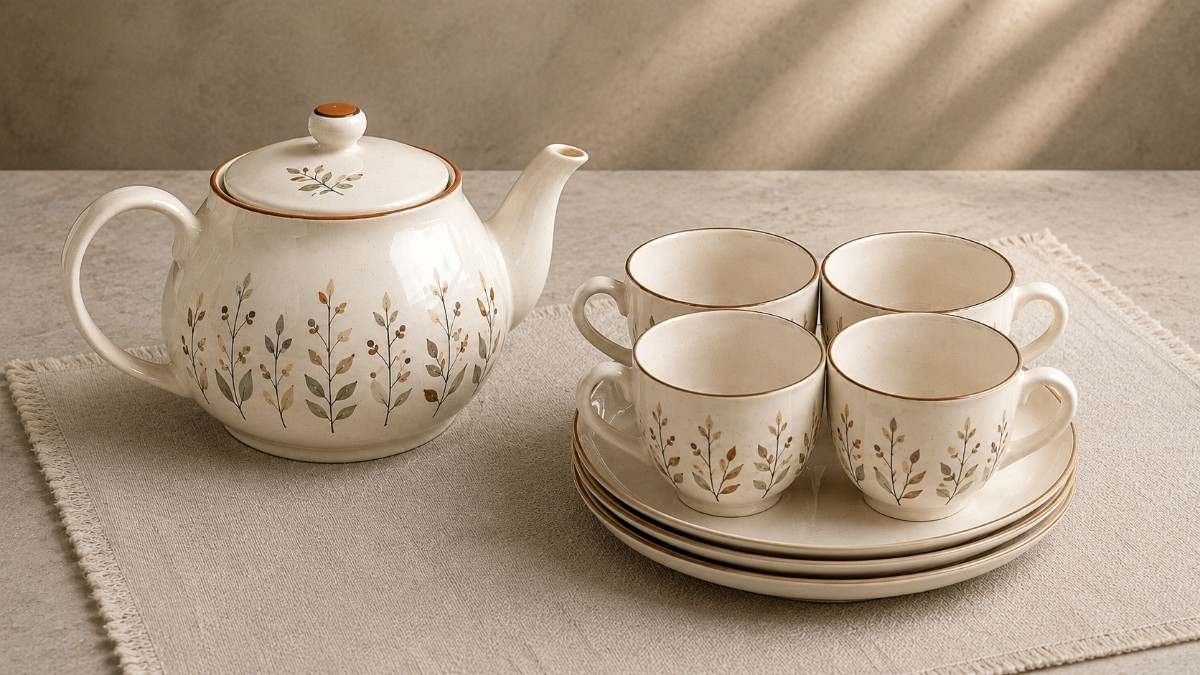
Mixing rather than matching
Matching tea ware is easy and safe. Mixing is more interesting and only slightly harder. Keep one element constant, usually the colour family, and vary the rest. A matte cream pot with glossy cream cups reads as intentional. The same pot with glossy blue cups and a printed saucer does not, which is why fully matching tea ware remains the low-risk choice online.Judging Finish, Colour and Elegance From a Screen
Screens exaggerate. Whites shift toward blue on most phones, so a set that photographs bright white is often ivory in daylight. Matte finishes photograph flatter than they look. Reactive glazes photograph more dramatic than they look. Three things reliably signal elegant tea crockery even through a photo: a flush-sitting lid, a spout with a cleanly cut tip, and a glaze that doesn’t pool at the foot. Gold rims read as luxurious on screen and carry real constraints, since they usually can’t go in the microwave and wear off over years of dishwashing. If two options look identical, go for the warmer one. Warm neutrals sit better under the yellow-toned LED lighting most Indian homes use at night, which is when a tea crockery set online tends to be judged hardest.Where Tea Serving Pieces Beyond the Set Come In
The pot and cups are the core. What actually makes the table are the small tea serving pieces around them: a tray to carry everything in one trip, a small strainer rest, side plates for snacks, and a lidded jar for sugar that doesn’t attract ants. Buy the tray last. It ties everything together, and you can only judge it once you know the real colour of everything else. Wooden trays flatter cream and sage. Black metal sharpens white porcelain. Cane suits stoneware and looks right on a balcony.Shipping a Tea Crockery Set Online: Damage and Delivery
Fragile items travel badly, and this is the practical bit most guides skip.- Check the packaging before opening. Double-boxed with foam inserts is a good sign; a single carton with newspaper is not.
- Unbox on video if the order is valuable. Most sellers require it for a damage claim.
- Inspect rims and spouts first. Hairline chips hide on the underside of a rim.
- Note the return window. Fragile goods often have shorter windows than other categories.
Frequently Asked Questions
Is it safe to buy a tea crockery set online?
Generally yes, provided you buy from a seller who lists exact materials, capacities and weights, and who packs fragile goods properly. Check whether the listing shows an interior shot of the pot, read reviews with customer photos, and confirm the return window for breakage before ordering.What should a good tea set include?
At minimum a pot, four cups and four saucers. Fuller sets add a milk jug, a sugar pot with a lid, and sometimes a tray or side plates. Decide based on how you serve: households that only make tea for the family rarely need the jug and sugar pot at all.How do I know the real colour before ordering?
Look at customer review photos taken indoors rather than the seller’s styled images. Screens push whites toward blue and flatten matte finishes, so assume the piece will be slightly warmer and duller in person. If two options look similar, the warmer one usually suits Indian evening lighting better.Can I add matching pieces to my set later?
Only reliably if you chose a plain glaze in a core colour. Printed and seasonal patterns get discontinued and can’t be topped up. Solid neutral ranges stay in production far longer, which is the main practical reason to favour them when you’re planning to build up gradually.Conclusion
Shopping for a tea crockery set online is mostly about reading listings properly rather than having a good eye. Insist on capacities in millilitres, weight per piece, a named material and clear microwave and dishwasher markings. Look at review photos for the true colour. Start with the pot and four cups, choose a plain glaze you can add to later, and leave the tray until the end. Handle the unboxing carefully and note the return window. If you’re stuck between two sets, explore the well-curated range from Shokki Decor to compare the details that matter. Get in touch and find a tea crockery set that suits your needs.Keep reading
Related stories

7 min read
Tea Set for Six Online: How to Choose One That’s Perfect for Hosting Guests
You’ve invited three couples over. The samosas are sorted, the house looks fine, and then you open the crockery cabinet and find four cups that match, two that don’t, and a pot with a chipped lid from Shokki Decor. Every

7 min read
Tea Pot and Cup Set Online: A Simple Way to Upgrade Your Tea Time
Most of us make good chai and then ruin the moment. The tea gets strained straight from a steel pan into whatever mug is closest, everyone stands around the kitchen counter, and it’s over in four minutes. Nothing wrong w

7 min read
Complete Tea Set Online: What Should a Good Set Include?
Two listings, same price. One says “15-piece tea set”, the other says “9-piece”. The 15-piece one sounds better until you notice it counts six saucers, six cups, a pot, a lid and a tray as separate items, while the 9-pie