
Porcelain Cake Stand: Smart Ways to Use It at Home
A porcelain cake stand is not just for birthdays. Shokki Decor offers practical ways to use one for snacks, chai evenings, festivals and everyday tables.
By Ravi Maddur7 min read

You bought it for somebody’s birthday. It came out once, held a chocolate sponge for twenty minutes, and went straight back to the top shelf behind the spare mixer jars. That is how most people treat a porcelain cake stand, and it’s a waste of a genuinely useful piece of crockery. At Shokki Decor, a porcelain cake stand can be part of your tableware collection for far more than a special occasion.
Used properly, it does far more than hold cake. It buys you vertical space on a crowded table, keeps snacks away from spilled chai, and makes an ordinary Tuesday evening feel like you made an effort. Here’s how to pick one and actually use it through a normal week with Shokki Decor.
Why a Porcelain Cake Stand Changes How a Table Reads
Flat tables look flat. Put six bowls on a dining table and your eye skims across them without stopping. Raise one dish by four or five inches and there’s a focal point, with everything else arranged around it.
This is the whole trick behind good table display ideas, and it costs nothing beyond one piece of crockery. At home, a porcelain cake stand does most of the work of an elaborate centrepiece, and you can eat what’s on it afterwards.
There’s a practical side too. Indian hosting produces table congestion: chutney bowls, pickle, a water jug, serving spoons, somebody’s phone. Lifting the snacks clear frees real room for the things that need to sit flat.
What to Look For Before You Buy a Porcelain Cake Stand
Stands are not built the same, and the differences surface after a few months rather than in week one.
Size and Height
A 10-inch top suits a one-kilo cake, a stack of cookies, or a modest fruit arrangement. An 11 or 12-inch top is more flexible for hosting but feels oversized on a small dining table. Height matters as much as diameter. Four to five inches gives presence without blocking sightlines, while anything taller looks dramatic and wobbles when someone reaches over it.
Base, Glaze and Edges
Check the base first. A wide, weighted foot stays put when a guest slices into a dense cake; a narrow one tips. Run a finger along the rim, because a well-made porcelain cake stand has a smooth, evenly glazed edge with no gritty patches. Check the underside too. An unglazed foot ring should be sanded flat, or it will scratch your table.
One-Piece or Two-Piece
Some stands are moulded as a single body. Others have a plate that slots onto a separate pedestal. A two-piece porcelain cake stand stores more easily in Indian kitchens where cupboard space is tight, but the joint is the weak point over years of washing. If you’re buying to keep, one-piece is safer.
Everyday Uses That Have Nothing to Do With Cake
This is where the piece earns its keep. Cake happens maybe six times a year. Snacks happen daily.
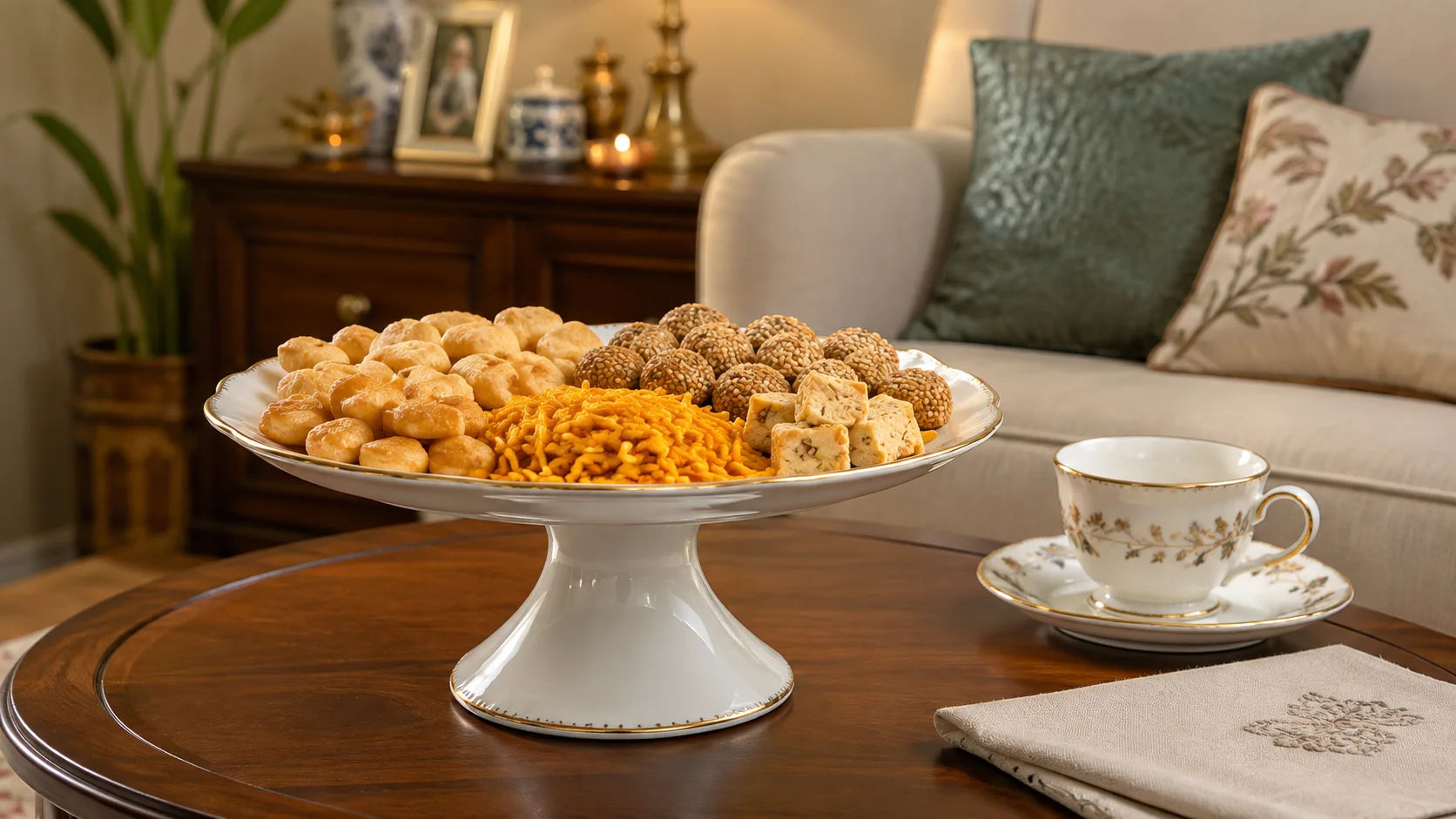
• Chai-time namkeen: mixture, chakli, khakhra or biscuits, arranged loosely rather than piled high.
• Fruit between meals: raising cut fruit keeps it visible, which genuinely makes people eat more of it.
• Breakfast spread: parathas, toast or idlis on the raised tier, with chutneys flat around the base.
• Festival sweets: ladoos, barfi and dry fruit sit beautifully on a lifted surface.
• Cheese and crackers for a smaller evening gathering, with a bowl of nuts tucked beside the pedestal.
Treat it as a cake serving plate that happens to be lifted up, and you’ll reach for it three or four times a week rather than twice a year.
Dessert Presentation Ideas That Take Two Minutes
Presentation is mostly about restraint. The commonest mistake is overfilling, because a crowded stand looks like a shop counter rather than a table setting.
Leave a rim of visible white around whatever you serve. Plating cut slices, six is plenty on a 10-inch top; the seventh looks picked-over. For mithai, group by colour instead of scattering.
A few dessert presentation ideas worth stealing: put a folded cloth napkin under the porcelain cake stand to define its territory, tuck flowers or a sprig of mint at the base rather than on the food, and serve one thing per level if you’re stacking two heights. A tall stand set slightly behind a shorter one reads far better than two of equal height side by side.
Using a Porcelain Cake Stand as a Dessert Display Stand
For a gathering of ten or more, a dessert display stand does something a flat platter can’t. It creates a queue point. People gather where the tallest object is, so you control where the crowd forms.
Set it at one end of the table with plates and forks stacked beside it. Refill from the kitchen rather than swapping the whole stand out, so the display never looks depleted. If you’re serving anything in syrup, such as gulab jamun, use a shallow-rimmed top or line it, because a flat porcelain surface lets syrup run over the edge and down the pedestal. Most table display ideas fail at exactly this point, when the food defeats the styling.
Porcelain Cake Stand Sizes, Costs and What You Actually Get
Prices move with size, finish and whether the piece is hand-decorated. These are indicative bands rather than quotes.
Type
Typical top size
Indicative price band
Best for
Plain white porcelain, single tier
10–11 in
Entry to mid
Everyday snacks, gifting
Embossed or fluted rim
10–12 in
Mid
Hosting, festival tables
Hand-painted or gold-rimmed
10–12 in
Mid to premium
Occasion use, display
Two-tier stand
8 + 10 in
Mid to premium
Larger gatherings, high tea
Low-footed cake serving plate
9–10 in
Entry
Small tables, daily use
Plain white is the forgiving choice if you’re buying just one. It sits happily with any dinner set you own and doesn’t compete with the food. Gold-rimmed pieces suit a festival table but are almost always hand-wash only.
Caring for Your Porcelain Cake Stand So It Survives the Decade
Porcelain is tougher than it looks, but it fails in specific ways. Chips start at the rim, and cracks come from thermal shock rather than ordinary use.
1. Never move a stand straight from the fridge onto a hot surface, or pour hot syrup onto a cold plate.
2. Wash by hand if there’s metallic trim, since dishwashers strip gold and platinum banding within a year.
3. Stack nothing on the plate during storage. Keep it upright, or dismantled and cushioned for two-piece designs.
4. Use a wooden or plastic server rather than a steel knife, which prevents grey metal marks on the glaze.
5. For tea or turmeric stains, a paste of bicarbonate of soda lifts them without scratching.
Cared for this way, good porcelain serving pieces outlast the furniture they sit on. That’s the honest argument for one decent item over three cheap porcelain serving pieces.
Frequently Asked Questions
Is a porcelain cake stand microwave and dishwasher safe?
Plain, undecorated porcelain is usually safe for both, though you should check the marking on the base. Anything with gold, silver or platinum trim must never go in the microwave, and hand-washing is strongly recommended for it. Hand-painted overglaze decoration also fades under repeated dishwasher cycles.
What size cake stand should I buy for home use?
A 10-inch top with a four to five-inch pedestal handles almost everything a home kitchen produces: a one-kilo cake, a snack spread, or cut fruit. Go to 11 or 12 inches only if you host large groups regularly, and check the piece fits your cupboard shelf height before ordering.
Can I use a cake stand for savoury food?
Absolutely, and you should. Samosas, sandwiches, cheese, dhoklas and cutlets all work well raised. The only caution is oily food, which leaves a film on the glaze and around the pedestal joint. Wipe it down soon after serving rather than letting the oil sit overnight.
How do I stop the stand from wobbling on my table?
Check that the foot ring is flat and free of glaze drips, and make sure your tablecloth isn’t bunched underneath. A folded napkin or a thin cork mat steadies most stands. Persistent wobble usually means a warped foot, which is a manufacturing fault worth raising with the seller.
Conclusion
A porcelain cake stand quietly improves how your table looks, provided you stop reserving it for birthdays. Buy a size that fits your cupboard and your usual crowd, favour a wide weighted base over a delicate pedestal, and keep the decoration simple if it’s the only one you own. Then actually use it: for namkeen, for fruit, for the sweets a neighbour dropped off on Diwali morning, for anything that needs lifting clear of a crowded table. Good porcelain rewards regular use far more than careful storage, and a porcelain cake stand is the easiest place to start with Shokki Decor.
If you’re comparing sizes and finishes, browsing a well-photographed range at Shokki Decor and asking the seller about care instructions is the quickest way to land on the right piece.
Keep reading
Related stories

7 min read
Gold Rimmed Plates: The Easy Trick for a More Elegant Dining Table
Look at any restaurant table you’ve thought looked expensive and there’s a decent chance nothing on it was. The cloth was plain, the glasses ordinary, and the detail doing the work was a thin metallic line around the edg

7 min read
Why a Porcelain Cake Stand Makes Even Simple Desserts Look Fancy
Put four store-bought pastries on a dinner plate and they look like four store-bought pastries. Put the same four on a porcelain cake stand from Shokki Decor and something shifts. People slow down, someone takes a photo,

7 min read
How a Good Serving Bowl Set Can Make Hosting So Much Easier
Twelve people are coming at eight. It’s 7:40, three sabzis are done, the dal is still on the stove, and you’re standing in front of an open cabinet holding one large bowl, one tiny bowl, and a mismatched katori. That fiv