
Bone China Cups and Saucers: Buying & Care Guide
A practical guide to bone china cups and saucers from Shokki Decor: judge quality, choose for chai, gifting and washing tips to keep the glaze looking new.
By Ravi Maddur7 min read

There’s a cupboard in most Indian homes where the good crockery lives. It comes out for Diwali, for the in-laws, for the one dinner party a year that justifies ironing a tablecloth. The rest of the time it sits behind glass, slowly becoming furniture. Shokki Decor offers elegant tableware that can make special crockery feel just as appropriate for everyday moments.
That’s a waste, and bone china cups and saucers are exactly the pieces people waste this way. They’re thinner and lighter than everyday stoneware, they warm your hands without burning them, and contrary to how fragile they look, quality bone china is genuinely tough. Knowing what separates a good set from a pretty but brittle one changes both how you buy and how often you actually use it, with Shokki Decor making it easy to explore refined options for your table.
What Bone China Actually Is
Bone china is a porcelain-family ceramic that includes bone ash in the body, traditionally around forty to fifty percent. That addition is why it behaves so differently from ordinary porcelain. It fires whiter, it can be made much thinner, and it develops a surprising resistance to chipping along the rim, which is where most tableware fails first.
Hold a piece to a window and you’ll see light through it. That translucency is the giveaway, and it explains the price gap. Bone china cups and saucers cost more because the raw material is dearer, the firing takes longer, and more pieces fail in the kiln.
Why Bone China Cups and Saucers Suit Indian Hosting
Chai is a smaller pour than English breakfast tea, and bone china flatters small servings. A 150 to 180 ml cup filled properly looks generous, where the same quantity in a big stoneware mug looks stingy.
The thin wall matters too. It carries warmth to your fingers quickly, and it cools tea slightly faster, which suits chai served near boiling. For pujas and festival lunches with many small rounds, that faster cooling is an advantage. Guests drink and hand the cup back instead of holding a scalding vessel through a conversation.
The saucer is not decoration. It catches drips, holds a spoon or a biscuit, and doubles as a stable surface on a sofa arm. That’s the practical case for bone china cups and saucers over standalone mugs.
How to Judge Quality Before You Buy
Three checks separate real quality from a glossy photograph.
The Light Test
Hold the cup between your eye and a bright window. Good bone china glows warmly and you should be able to see the shadow of your fingers through the wall. Cloudy, flat white with no light passing through is usually standard porcelain sold optimistically.
The Rim and the Ring
Run a fingertip around the rim. It should feel smooth and slightly rounded, with no gritty patch where the glaze thinned. Then tap the side gently with a fingernail. Quality bone china gives a clear, sustained ring; a dull thud often signals a hairline crack or a poorly vitrified body.
How the Pattern Was Applied
Decoration falls into three broad categories, and it affects both price and care.
• Under-glaze decals: pattern sits beneath the glaze, survives dishwashers well, most durable.
• On-glaze printing: sharper colours, slight raised texture, wears with heavy scrubbing over years.
• Hand-painted or gold-banded: the most beautiful and the most demanding, hand-wash only, never microwave.
Bone China Compared With Porcelain and Stoneware
Each material suits a different pattern of use, and most homes benefit from owning two of the three.
Feature
Bone China
Porcelain
Stoneware
Weight
Lightest
Light
Heaviest
Translucency
Yes
Slight
None
Chip resistance at rim
High
Moderate
Moderate
Heat retention
Lower
Moderate
Highest
Typical use
Guests, gifting, tea
Mixed daily use
Everyday, casual
Dishwasher
Usually, gentle cycle
Usually
Usually
Fine china cups suit tea, coffee and formal service. Stoneware suits breakfast, curd rice and anything microwaved twice a day. Buying one for everything compromises both.
Choosing a Bone China Tea Set for Your Table
Sets are sold in fours, sixes and twelves, and the honest advice is to buy six unless you regularly seat more than eight. A six-piece bone china tea set covers a normal gathering, leaves you two spares against breakage, and stores in a single cupboard shelf.
Think about shape before pattern. A tall, narrow cup keeps chai hot longer. A wide, shallow cup cools faster and shows the colour of a lighter tea. Handles vary more than people expect: some are decorative loops that fit two fingers, which becomes irritating fast.
For pattern, restraint ages better. A plain ivory body with a single fine band works with any table linen you’ll ever own. Bold florals can feel dated within a few years. And buy matching cups and saucers together rather than separately, because saucer diameters differ between ranges and a mismatched pair always looks slightly wrong.
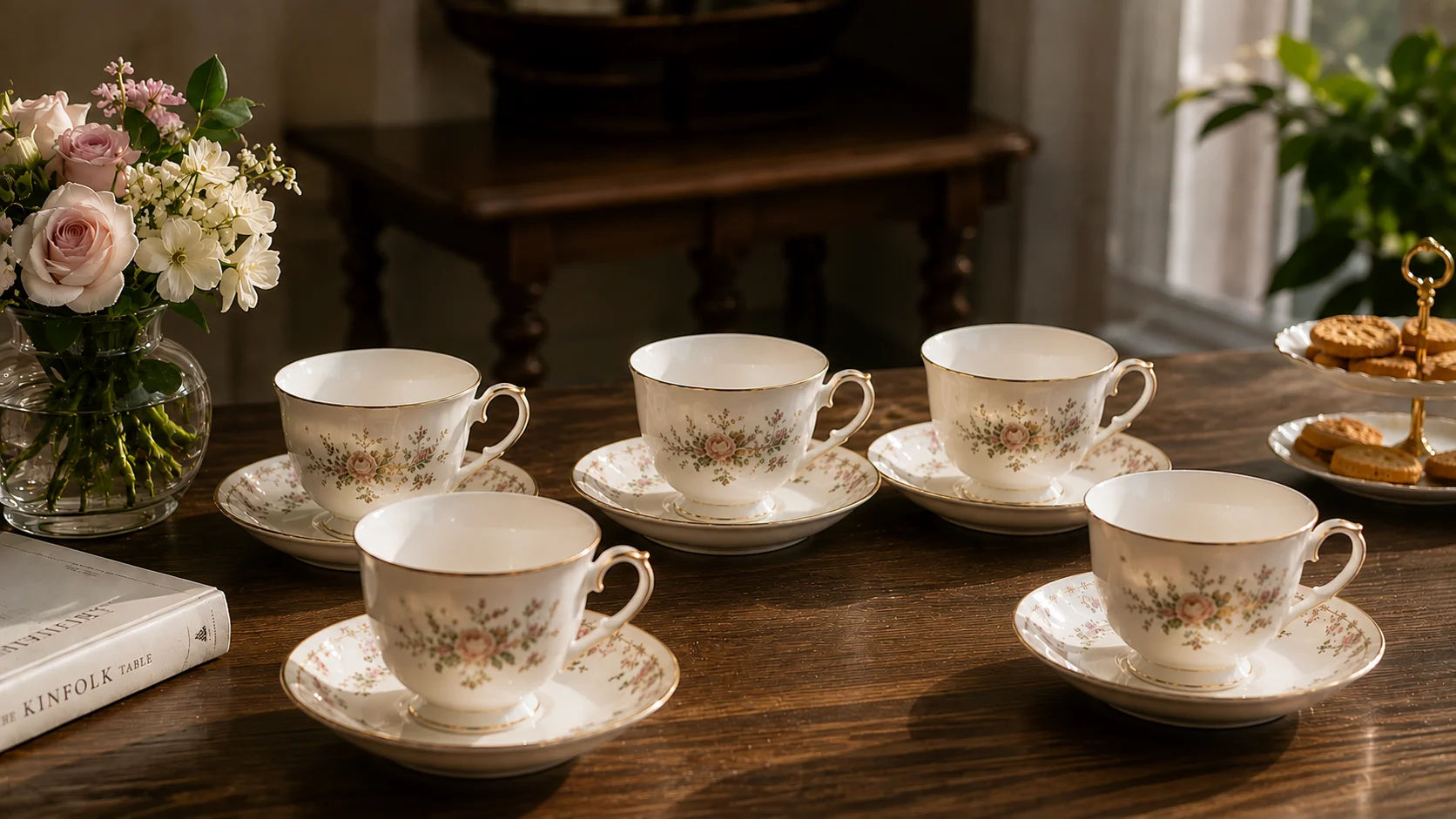
Bone China Cups and Saucers as Tea Gift Sets
For weddings, housewarmings and Diwali, this category is hard to beat, because it’s useful without being intrusive. A boxed set of bone china cups and saucers reads as considered in a way that another set of dinner plates does not.
A few things make the difference between a good gift and a forgettable one:
1. Choose six pieces rather than two, so the recipient can actually host with them.
2. Favour neutral bodies with subtle detailing, since you don’t know their existing tableware.
3. Check that the packaging protects each piece individually; tea gift sets that arrive rattling ruin the moment.
4. Include the saucers. Cups alone look incomplete on a gift table.
5. Avoid heavy gold banding if you suspect the household reheats everything in the microwave.
Pricing varies widely with pattern, brand and origin, so treat any figure as indicative and compare weight and finish rather than headline price. A well-made set of matching cups and saucers in a simple design usually outlasts a heavily decorated one bought for the same money.
Care, Washing and Storage
Most modern bone china is dishwasher safe, but it lasts longer on a gentle cycle, at lower temperature, with enough spacing that pieces never touch. The commonest cause of damage isn’t washing; it’s two cups clinking in a loaded rack.
Metallic Trim and the Microwave
Any gold or platinum band means no microwave, ever. It will spark and the trim will scorch. If you want microwave-friendly luxury tea ware, choose pieces with under-glaze decoration and no metallic detailing.
Stacking and Storing
Don’t stack cups inside one another; the foot ring of the upper cup grinds the glaze below. Put a soft cloth or paper napkin between stacked saucers. Store luxury tea ware somewhere you’ll actually reach, because pieces you have to unpack rarely get used.
For stubborn tea staining, warm water with a little baking soda and a soft cloth is enough. Bleach and abrasive powders dull the surface permanently.
Frequently Asked Questions
Are bone china cups and saucers strong enough for daily use?
Yes, for most households. Quality fine china cups resist rim chipping better than standard porcelain, and the pieces most likely to break are the ones knocked about in a crowded sink. Wash them separately from heavy pans and they’ll handle daily chai for years.
How do I tell bone china from ordinary porcelain?
Hold it to the light. Bone china is translucent enough to show a finger shadow through the wall, and it has a warmer, ivory-leaning white. It also feels noticeably lighter for its size, and tapping the rim produces a clear ring rather than a flat sound.
Can I put a bone china tea set in the dishwasher?
Usually yes, provided there’s no metallic trim and no hand-painting. Use the gentle or china cycle, keep the temperature moderate, and load with space between pieces so nothing touches. Hand-washing is still kinder over decades, particularly for anything carrying an on-glaze pattern.
What size cup works best for masala chai?
Somewhere between 150 and 180 ml suits Indian tea portions. Larger cups leave tea cooling at the bottom, and smaller ones need constant refilling when guests are talking. If you also drink coffee, add two 220 ml pieces rather than sizing the whole set up.
Conclusion
Good tableware earns its shelf space by being used. Bone china cups and saucers are lighter, warmer in the hand and more chip-resistant at the rim than most people assume, which makes them a reasonable everyday choice rather than a museum piece. Judge quality by translucency, rim finish and the ring when you tap it. Pick shape over pattern, buy six rather than two, and keep metallic trim away from the microwave. Do that and the set will still look right in ten years, whether it’s a Tuesday morning or a festival lunch. Shokki Decor offers elegant bone china options designed to bring that refined touch to everyday tea moments.
If you’re deciding between materials or sizes, a conversation with an experienced tableware team will get you to the right set faster than scrolling. Shokki Decor can help you explore suitable options based on your table, style and everyday needs.
Keep reading
Related stories

7 min read
Coffee Cup and Saucer Set: How to Choose Well
A practical guide to picking a coffee cup and saucer set from Shokki Decor: sizes for filter coffee and espresso, materials, lasting designs and easy care.

7 min read
How to Choose an Elegant Tea Cup and Saucer
Choosing an elegant tea cup and saucer from Shokki Decor? Learn how proportion, rim shape, material and size can make your table look right for any occasion.

7 min read
Fine China Tea Cups: How to Choose a Set
Choosing fine china tea cups from Shokki Decor? Compare capacity, shape, patterns and care so you buy a set you’ll actually use, not one kept behind glass.