
How to Choose an Elegant Tea Cup and Saucer
Choosing an elegant tea cup and saucer from Shokki Decor? Learn how proportion, rim shape, material and size can make your table look right for any occasion.
By Ravi Maddur7 min read

Serve chai to guests in mismatched mugs and nobody says anything. They notice, though. There’s a small gap between a household that pours tea and one that serves it, and the vessel is most of the difference. Shokki Decor offers elegant tableware that can make everyday tea service feel more considered.
An elegant tea cup and saucer closes that gap without much effort or expense. The trouble is that “elegant” gets used to describe everything from gold-encrusted showpieces to plain white porcelain, and the two suit completely different homes. What follows is a way of narrowing the choice by occasion, proportion and material, rather than by whichever product photograph looks best on a phone screen. Shokki Decor brings together refined tea tableware suited to different styles and occasions.
Start With the Occasion, Not the Pattern
Ask yourself how many times a year the piece will be used, and by whom. That single question does most of the work.
For daily chai, the priorities are weight, handle comfort and dishwasher tolerance. For two festival lunches and the occasional formal guest, you can accept hand-washing and metallic trim in exchange for a striking look. For a gift, you’re choosing blind, which argues for neutral colours and classic shapes.
Most homes end up needing two tiers: a set used weekly and a smaller set kept for occasions. Trying to serve both purposes with one purchase is the reason so many cupboards contain a set nobody quite likes.
What Makes an Elegant Tea Cup and Saucer Look Right
Elegance in tableware is mostly proportion and restraint. Three details do the heavy lifting.
Proportion Between Cup and Saucer
The saucer should be read as a frame, not a plate. As a rough guide, a saucer roughly 1.6 to 1.9 times the cup’s rim diameter looks balanced. Much wider and the cup looks marooned; much narrower and the pairing feels cramped. This is the main reason a matching cup and saucer from a single range beats two pieces bought separately.
The Rim, the Foot and the Handle
A fine, slightly outward-turned rim feels better against the lip and reads as more refined than a thick blunt edge. A defined foot ring lifts the cup visually. The handle should have a genuine gap for two fingers and sit high on the body, so your knuckles stay clear of hot ceramic.
Colour and Finish
White and ivory bodies flatter tea colour and go with everything. Deep colours look dramatic but hide the liquor, which matters for lighter teas. Glossy glazes read formal, matte glazes read contemporary, and embossed texture gives richness without the maintenance burden of gold.
Material: What Each One Gives You
Material
Look
Durability
Practical notes
Bone china
Thin, translucent, warm white
High rim strength
Light, formal, usually gentle-cycle safe
Porcelain
Crisp, cool white
Very good
The best all-round choice
Stoneware
Solid, artisanal
Very good
Heavier, best heat retention
Glazed ceramic
Varied, textured
Good
Widest range of colours and finishes
Glass
Modern, shows the tea
Moderate
Cools fast, needs a handle for chai
Porcelain is the sensible default if one set has to do everything. Bone china is the choice when lightness and a formal feel matter more than hard daily handling. Stoneware suits a relaxed table and holds heat best, which some people prefer for slow evening tea. Whichever you pick, buy the elegant tea cup and saucer as a pair from the same range so the glaze tones match exactly.
Sizing for Chai, Green Tea and Coffee
Capacity is where good-looking sets most often disappoint. Indian tea is poured small and strong, so a 250 ml cup leaves half the tea cooling.
• 90–120 ml: small, sharp servings for evening guests and quick rounds.
• 150–180 ml: the everyday masala chai sweet spot for most households.
• 200–240 ml: green tea, herbal infusions, anything sipped slowly.
• 250–300 ml: milk coffee and weekend breakfasts, better served in a larger cup entirely.
If your household is split between tea and coffee drinkers, buy six premium tea cups in the 150–180 ml range and two larger pieces separately. It costs marginally more and avoids a set that suits nobody properly. Sizing is also where an elegant tea cup and saucer bought online most often surprises people, so read the millilitre figure rather than judging by the photo.
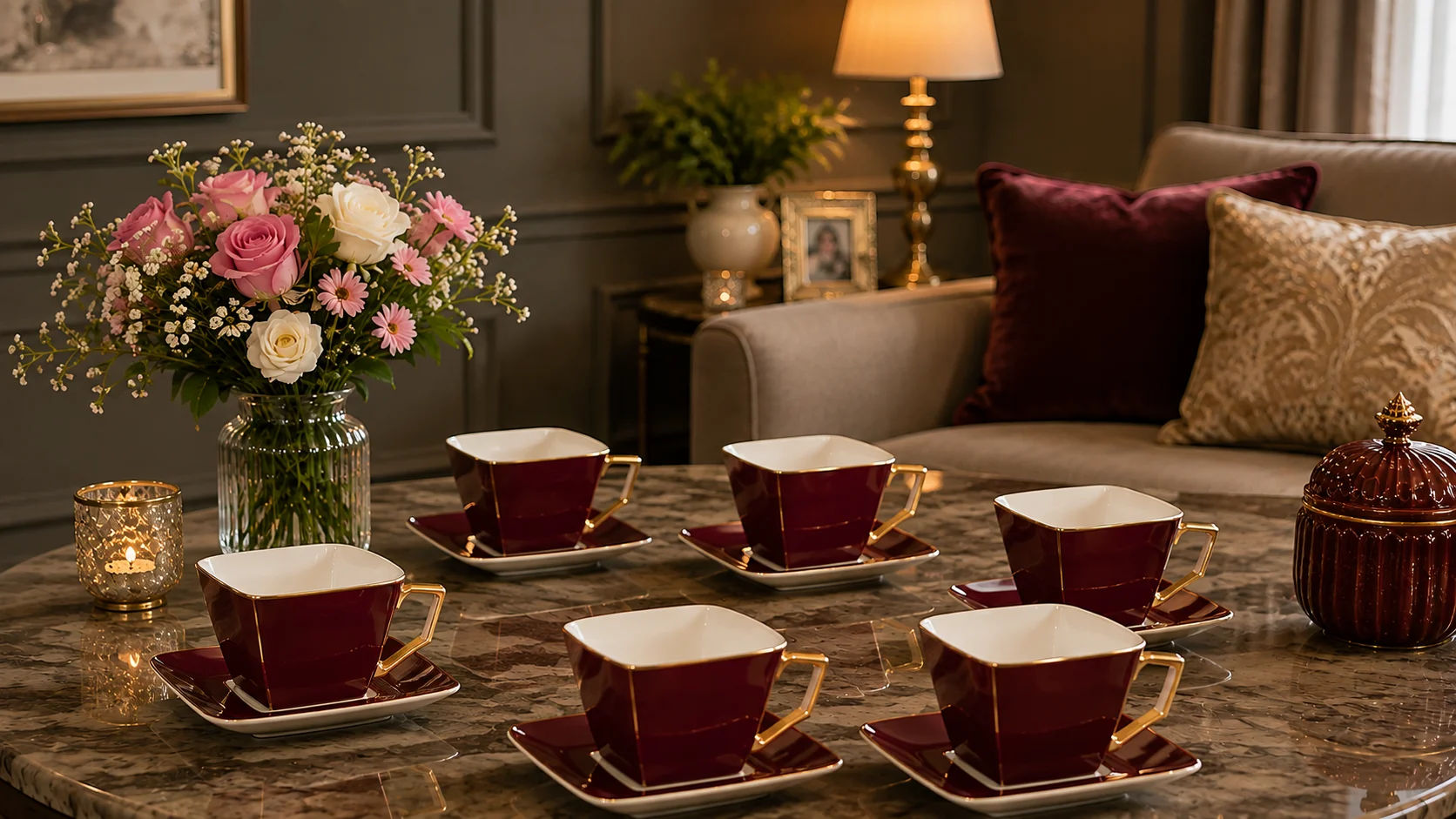
Building a Tea Table Setting Around Your Cups
Once the cups are chosen, the table needs to support them rather than compete. Keep the surface plain, and let the cups be the detail.
A workable approach for a small gathering:
1. Lay a neutral runner or plain linen down the centre of the table.
2. Place the saucer first, cup handle turned to the right at roughly four o’clock.
3. Rest the teaspoon on the saucer behind the cup, not beside the plate.
4. Add one shared element in the centre, a teapot or a small platter of snacks, and stop there.
5. Leave gaps. Space is what makes a tea table setting look considered rather than crowded.
For festival hosting, when sweets and savouries take over the table, drop the ornament entirely and let the food carry the colour. An elegant tea cup and saucer in a plain body will hold its own against a crowded spread far better than a heavily patterned one.
Elegant Tea Sets for Gifting
Tableware is a good wedding or housewarming gift precisely because it gets used. A few rules keep it from becoming another boxed item on a shelf.
Buy six pieces rather than two, so the recipient can actually host. Stay neutral in colour, since you don’t know what they own. Check that packaging protects each piece individually, because stylish tea ware that arrives rattling never quite recovers its charm. And think about whether the household microwaves everything, in which case skip metallic trim entirely.
Elegant tea sets sold with a teapot, sugar pot and creamer look generous, but the cups do the real work. If the budget is limited, better to give six excellent cups than twelve mediocre pieces.
Using an Elegant Tea Cup and Saucer Every Day
The best argument for good tableware is frequency. A cup used twice a year is an ornament; the same cup used daily changes an ordinary morning slightly for the better.
Washing
Most glazed and under-glaze pieces handle a gentle dishwasher cycle at moderate temperature. Metallic trim never goes in, nor does hand-painted on-glaze work. Load with space between items, because chips come from contact more often than heat. For tea staining, baking soda paste on a soft cloth clears the ring.
Storage
Store cups upright and never nested. Stack saucers with a napkin between each. Keep stylish tea ware at a height you can reach without a stool, because inconvenient storage is the single biggest reason a set stops being used.
Frequently Asked Questions
What size elegant tea cup and saucer works best for Indian chai?
Aim for 150 to 180 ml. Indian tea is served in smaller, stronger pours, so anything larger leaves you with lukewarm tea at the bottom. Saucer diameter should be roughly 1.6 to 1.9 times the cup rim, which keeps the pairing balanced rather than looking oversized.
Can I mix cups and saucers from different sets?
You can, but keep either the colour or the shape consistent, and check the cup’s foot sits properly in the saucer well. A matching cup and saucer from one range avoids the problem entirely. Mixing works best when the shapes agree and only the glaze colours vary.
Is bone china or porcelain better for everyday use?
Porcelain, for most households. It handles daily washing well and looks formal enough for guests. Bone china is lighter and finer in the hand, and many people prefer it for tea specifically, though it rewards a little more care. Premium tea cups in either material will last if handled sensibly.
How many pieces should I buy?
Six covers a normal gathering and leaves spares after the inevitable breakage. Four suits a couple who rarely host. Twelve is only worth the storage if large family lunches are a regular fixture. Buying an elegant tea cup and saucer set of six is the safest default.
Conclusion
Choose by occasion first, then by proportion, then by material. A saucer that frames the cup properly, a fine rim, a comfortable handle and a capacity that matches how you actually drink will do more for the look of your table than any pattern. Keep colours restrained if the set has to work year-round, and save metallic detailing for pieces you’re happy to hand-wash. An elegant tea cup and saucer chosen this way stays in daily circulation instead of behind glass, which is the whole point of owning it. Shokki Decor offers elegant tea cup and saucer options suited to everyday use and special occasions.
If you’re unsure which material or size fits your household, a conversation with an experienced tableware team like Shokki Decor will settle it quickly.
Keep reading
Related stories

7 min read
Coffee Cup and Saucer Set: How to Choose Well
A practical guide to picking a coffee cup and saucer set from Shokki Decor: sizes for filter coffee and espresso, materials, lasting designs and easy care.

7 min read
Fine China Tea Cups: How to Choose a Set
Choosing fine china tea cups from Shokki Decor? Compare capacity, shape, patterns and care so you buy a set you’ll actually use, not one kept behind glass.

7 min read
Bone China Cups and Saucers: Buying & Care Guide
A practical guide to bone china cups and saucers from Shokki Decor: judge quality, choose for chai, gifting and washing tips to keep the glaze looking new.