
Choosing a Tea Cup Set with Saucers for Daily Use
Picking a tea cup set with saucers for everyday tea time? Shokki Decor helps you compare capacity, handle comfort, material and care so you choose a set to enjoy daily.
By Ravi Maddur7 min read

There’s a set in most Indian homes that only appears when someone important visits. The rest of the year, tea gets poured into steel tumblers or a chipped mug with a company logo on it. If you’re choosing a tea cup set with saucers, Shokki Decor offers elegant options, the goal is to buy something good enough for guests and comfortable enough to use on a Wednesday morning.
Those two requirements pull in different directions, which is why so many people end up owning both and enjoying neither. Get the specification right and one set from Shokki Decor can genuinely do both jobs.
Let Everyday Use Decide Your Tea Cup Set with Saucers
Start with the tea you actually make. A household that boils milk, tea leaves, ginger and cardamom together needs something different from one that steeps green tea for three minutes.
Boiled chai is served hot, in small quantities, and topped up. Lighter teas are drunk slowly, so the cup must hold temperature for fifteen or twenty minutes. One set can serve both, but only if you pick the middle ground deliberately.
The second question is who washes up. If the set goes through a dishwasher, metallic trim is out from the start. Hand-washing gives you more freedom, but somebody will eventually stack them carelessly, so thin rims carry real risk.
Capacity Is the Number That Matters Most
More sets get returned over size than over pattern. Listings often describe cups as “standard”, which means nothing, so look for capacity in millilitres.
For Strong Boiled Chai
Between 90 and 150 ml. Small cups keep tea hot to the last sip, which is exactly why the traditional Indian chai cup is small. You’ll pour more often, and that’s fine, since the pot is usually on the table anyway.
For Green, Herbal and Lighter Teas
Between 170 and 200 ml suits a slower drinker. Straight sides hold heat better than flared ones, and a slightly thicker wall helps further. Above 220 ml you’ve bought a mug with a saucer, which rarely feels right at a laid table.
If you want one set for everything, 150 ml is the honest compromise. It’s a little large for chai and a little small for a long green tea, and it annoys nobody.
Weight, Balance and Handle Comfort
This is the part photographs can’t tell you, and the part you’ll notice every day.
The Handle
A handle should take two fingers with the thumb resting on top. Plenty of elegant tea cups carry a small decorative loop that fits one finger, and a full cup then hangs awkwardly. The most elegant tea cups solve this quietly, so check side-on photographs before ordering.
Rim and Wall Thickness
A thin rim feels refined against the lip and chips first. A thick rim survives a busy kitchen and feels blunt. Two to three millimetres suits most homes. Weight per cup is a fair proxy: lighter usually means a denser, better-fired body rather than a flimsy one.
Material: The Choice That Shapes Everything Else
Material decides almost everything else about a tea cup set with saucers, including price and care.
Material
Everyday suitability
Heat retention
Care
Porcelain
Excellent, the default choice
Good
Dishwasher safe when undecorated
Bone China
Very good, feels finest in hand
Good
Hand-wash preferred, chips at thin rims
Stoneware
Good for casual, heavy daily use
Moderate, cools faster
Very forgiving, often dishwasher safe
Glazed ceramic
Variable by maker
Moderate
Check glaze quality before buying
For most households, porcelain is the answer. It takes boiling water without complaint, resists staining better than cheap ceramic, and looks composed whether you’re serving a neighbour or your mother-in-law. Bone china is the upgrade, and the difference is real in the hand. Stoneware suits homes where tea is drunk in volume and pieces get knocked about.
Matching Tea Cup Set or a Deliberate Mix
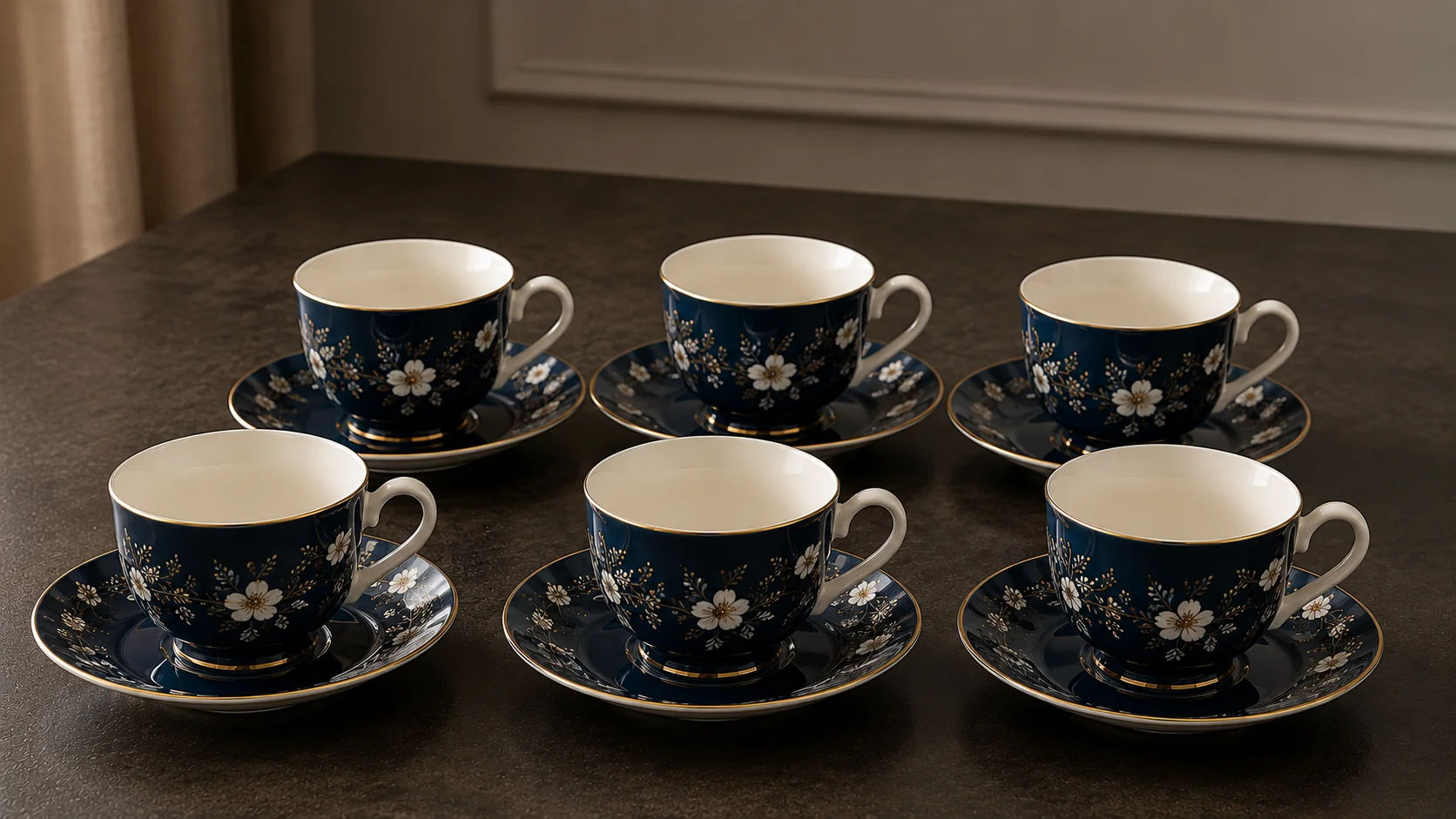
A matching tea cup set is the low-risk choice, and six identical pieces are anything but boring if the shape is good. It also makes replacement simpler, assuming the range stays in production.
Mixing works, but it needs a rule:
• One colour, varied texture. All white, with different embossing across the cups.
• One shape, varied colour. The same silhouette in four or five muted shades.
• Plain cups, patterned saucers. Adds interest without dominating the table.
What fails is buying from unrelated ranges. Diameters differ by millimetres between makers, and a cup that overhangs its saucer reads as a mistake. If you like the mixed look, buy tea cups with saucers as pairs and mix at set level, not piece level. Sold as pairs, tea cups with saucers are always proportioned to each other.
Storing a Tea Cup Set with Saucers, Plus Tea Table Accessories
Cabinet space decides more purchases than people admit. Measure your shelf height first, because a tall cup with a wide saucer needs more room than the photograph suggests.
Stack saucers separately, and never nest cups inside one another without something between them. A folded napkin or felt pad prevents the ring-shaped scuffs that appear on white glaze after a year. With metallic banding, stacking is what wears it away, not washing.
A few tea table accessories earn their place beside a tea serving set: a tray to carry six cups in one trip, a strainer stand so the wet strainer isn’t parked on a saucer, and a lidded sugar pot. Skip the rest until you know what you reach for.
Washing, Staining and Chips
Tea stains porcelain. Tannin builds up as a brown film inside the cup, particularly with strong chai, and it doesn’t come off with normal washing-up liquid.
1. For staining, use a paste of bicarbonate of soda and water, worked in with a soft cloth.
2. Avoid steel scourers entirely, since the scratches they leave hold stains worse than the original film.
3. Don’t pour boiling water into a cup straight from a cold cabinet in winter; warm it first.
4. Hand-wash anything with gold or platinum trim, always.
5. Rinse and dry rather than leaving cups to soak overnight, which loosens handle joins over years.
Done consistently, a good set stays presentable for a decade. That’s the argument for one decent set over replacing a cheap one every couple of years.
How Many Pieces You Actually Need
Six cups with six saucers is the sensible default for an Indian household, and it absorbs unannounced guests. Eight makes sense if you host during festivals, when cups leave the shelf faster than they come back clean.
Check what the listing counts when comparing prices for a tea cup set with saucers. A “twelve-piece tea serving set” usually means six cups and six saucers, not twelve cups. If the range restocks, starting with six and adding later is reasonable.
Frequently Asked Questions
What size is best for a tea cup set with saucers?
For boiled Indian chai, 90 to 150 ml keeps tea hot until the last sip. For green and herbal teas drunk slowly, 170 to 200 ml works better. If you want one set covering both, 150 ml is the fairest compromise, and it still looks proportionate on a standard saucer.
Are porcelain cups safe in the microwave and dishwasher?
Plain, undecorated porcelain is generally safe for both, though the marking on the base is the final word. Gold, silver or platinum trim must never go in a microwave, and those pieces should be hand-washed. Overglaze hand-painting also fades under repeated dishwasher cycles.
How do I remove tea stains from white cups?
Make a paste of bicarbonate of soda and a little water, and work it around the inside with a soft cloth or sponge. Leave it a few minutes on stubborn marks. Avoid steel scourers and harsh abrasives, because the fine scratches they leave will trap stains far more quickly next time.
Should the cups and saucers match exactly?
They don’t have to, but they should relate. Matching pairs are the safe route and simplify replacement later. If you prefer variety, keep one element constant across the set, whether that’s colour, shape or the saucer, and check that cup and saucer diameters are designed to sit together.
Conclusion
Choosing a tea cup set with saucers is mostly about being realistic. Pick the capacity that suits the tea your household actually drinks, check the handle takes two fingers, choose a material you’re willing to look after, and measure your cabinet before ordering. Pattern is the last decision, not the first. Buy six if you’re cautious and eight if you host, and favour a range that restocks so one breakage doesn’t retire the whole set. A well-chosen tea cup set with saucers stops being special-occasion crockery and becomes the thing you reach for at breakfast. Shokki Decor offers elegant tea cup sets to suit everyday tea moments and special gatherings alike.
If you’re unsure which material or size fits how your household drinks tea, asking an experienced seller like Shokki Decor for capacities, weights and care details before you order will save you a return later.
Keep reading
Related stories

7 min read
Coffee Cup and Saucer Set: How to Choose Well
A practical guide to picking a coffee cup and saucer set from Shokki Decor: sizes for filter coffee and espresso, materials, lasting designs and easy care.

7 min read
How to Choose an Elegant Tea Cup and Saucer
Choosing an elegant tea cup and saucer from Shokki Decor? Learn how proportion, rim shape, material and size can make your table look right for any occasion.

7 min read
Fine China Tea Cups: How to Choose a Set
Choosing fine china tea cups from Shokki Decor? Compare capacity, shape, patterns and care so you buy a set you’ll actually use, not one kept behind glass.