
Tea Cup and Saucer Online: Find a Set You’ll Love
Shopping for a tea cup and saucer online? Shokki Decor helps you judge size, saucer depth, material and finish so you choose a set you’ll use every day.
By Ravi Maddur7 min read

Most people own two kinds of cups. The ones they reach for at 7am without thinking, and the pretty set in the display cabinet that comes out three times a year. If you’re about to buy a tea cup and saucer online, Shokki Decor offers a range worth exploring, the whole job is making sure you end up with the first kind rather than the second.
That’s harder than it sounds. Listings sell you a mood: soft light, a folded napkin, a biscuit placed just so. What they rarely tell you is whether the cup is comfortable to hold when it’s full, or whether the saucer will actually catch a drip. With Shokki Decor, you can explore tea cup and saucer options with everyday use and style in mind.
What Usually Goes Wrong With a Tea Cup and Saucer Online
The three common regrets are predictable. The cup is too big, the saucer is too flat, or the whole thing is too precious to use daily.
Size trips up more buyers than anything else. A 250 ml cup looks generous in photos, but it’s wrong for the small, hot, frequently topped-up chai most Indian households drink. Halfway down a large cup, the tea has gone lukewarm.
The second problem is the saucer with no well. A perfectly flat saucer looks clean in photographs and does nothing useful, because the cup slides on it every time you carry it across the room.
Start With How You Actually Drink Tea
Before you compare designs for a tea cup and saucer online, be honest about your household’s habits. The answer changes the specification completely.
If You Drink Strong Boiled Chai
Go small. Somewhere between 90 and 150 ml keeps tea hot to the last mouthful, which is why the traditional Indian cup is sized the way it is. A thicker wall helps too, and a slightly narrower mouth slows cooling. You’ll refill more often, which is exactly what happens in most homes anyway.
If You Sip Slowly
Green tea, herbal infusions and lightly brewed black tea are drunk over fifteen or twenty minutes. Here a 180 to 200 ml cup with a straight side makes more sense, and a slightly thicker body keeps the temperature steady. This is also the group that benefits most from a lid or a broader saucer that doubles as a cover.
The Saucer Is Not Just Decoration
A good saucer earns its place. It catches drips from the rim, gives you somewhere to park a wet spoon, and stops a hot cup from marking a wooden table.
Look for a defined well: a shallow recess, one or two millimetres deep, that the cup foot sits into. Without it the cup travels. Diameter matters too, and a useful rule is a saucer roughly one and a half times the cup’s outer width. Wider eats table space; narrower leaves biscuits nowhere to go.
Check the underside too. An unglazed, unsanded foot ring on the saucer will leave grey scratch marks on a polished dining table within weeks.
Matching Tea Cups and Saucers, or Mixing on Purpose
Buying a set of matching tea cups and saucers is the safe route, and there’s nothing dull about it if the shape is good. Six identical pieces on a tray read as considered rather than accidental.
Mixing works too, but only with a rule holding it together. Pick one of these:
• Same colour, different pattern. All white, with varied embossing or texture.
• Same shape, different colour. Identical silhouette in four or five muted shades.
• Neutral cups, patterned saucers. The cheapest way to add interest without committing.
What doesn’t work is buying a pretty cup here and an unrelated saucer there, hoping they’ll sit well together. Rim diameters vary by several millimetres between makers, and a cup that overhangs its saucer looks like a mistake, because it is one.
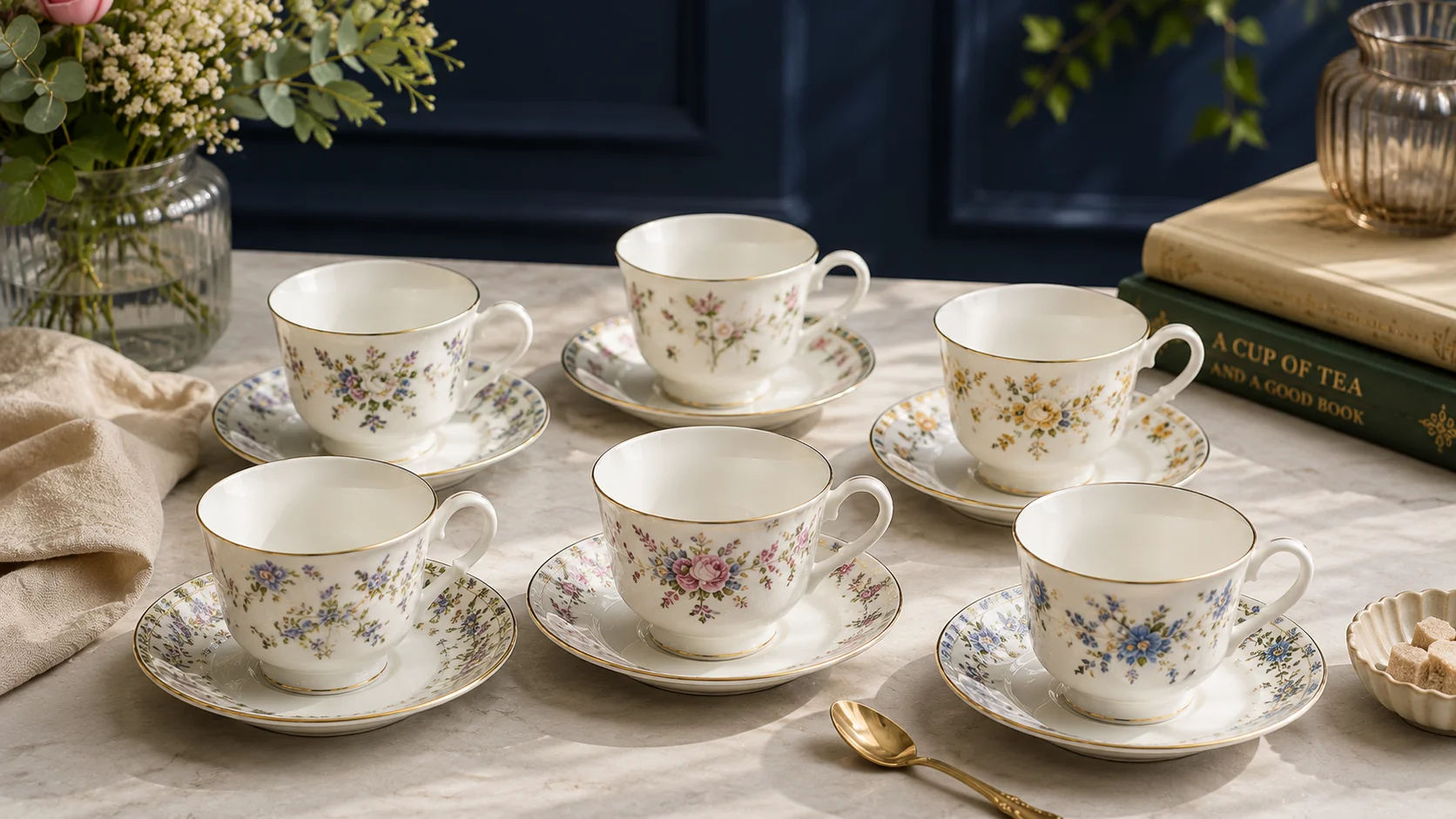
Materials and Weight in Tea Tableware
Material decides how a set feels and how long it lasts. Since you can’t pick up a tea cup and saucer online, weight is your shorthand: lighter usually means finer, denser and better fired.
Material
Feel
Best for
Trade-off
Porcelain
Smooth, medium weight, holds heat
Everyday tea tableware
Plain glazes show tea staining if neglected
Bone China
Light, thin, slightly translucent
Guests, gifting, elegant tea sets
Costs more, thin rims chip when stacked
Stoneware
Heavy, matte, rustic
Strong chai, casual use
Cools tea faster, bulky in a cabinet
Glazed ceramic
Variable, often thicker
Budget buys, colour
Glaze quality varies a lot between batches
For most homes, porcelain hits the sweet spot. It handles boiling water, goes through a dishwasher when undecorated, and looks appropriate whether you’re serving a neighbour or your in-laws. Bone china is the upgrade, and the difference is genuinely noticeable in the hand rather than only on paper.
Comparing Tea Cup Sets Without Getting Overwhelmed
Once you’ve fixed material and capacity, most listings fall away. Compare the survivors on four points only.
1. Piece count and what’s included. Some tea cup sets list twelve pieces, meaning six cups and six saucers, which is not the same as twelve cups.
2. Care instructions. Metallic rims mean hand-wash and no microwave, permanently.
3. Restock and replacement. Discontinued lines leave you unable to replace a broken cup.
4. Handle comfort. Look for a loop that takes two fingers plus the thumb, and check the photo from the side.
Most people buy six. Eight is the smarter number if you host during festivals, since cups go out faster than they come back clean.
Elegant Tea Sets for Gifting and Festival Tables
Tea sets are among the safest gifts in Indian homes, which is why so many people order a tea cup and saucer online around Diwali and wedding season. If you’re buying to give, lean neutral and keep decoration restrained. Elegant tea sets in white, ivory or soft grey suit almost any interior; a bold pattern is a gamble on someone else’s taste.
Packaging matters more than usual for gifting. A set that arrives in a printed box with moulded inserts can be handed over as it is. One that arrives wrapped in newspaper inside a plain carton needs work before you can give it to anyone.
Reading a Tea Cup and Saucer Online Listing Properly
Slow down at the specification block. You want capacity in millilitres, weight per piece, saucer diameter, material named exactly, and a clear statement on microwave and dishwasher use. If the seller hasn’t published those, ask before ordering rather than after.
Then read the photographs as a buyer, not as the stylist intended. Check the rim for evenness, the handle join for seams, and the group shot for consistency between pieces. Ordering tea serving ware sight unseen is fine when a listing is detailed and risky when it isn’t. Good sellers of tea serving ware publish those details without being asked.
Frequently Asked Questions
How many cups should a tea set have?
Six cups with six saucers suits most Indian households and covers unexpected guests. Choose eight if you host regularly during festivals or have a large family, because washing up mid-gathering is nobody’s idea of hospitality. Buying from a range that restocks lets you start with six and add later.
Is it safe to order a tea cup and saucer online?
Yes, if the seller describes packaging properly and has a stated policy on transit damage. Photograph the sealed carton and film the unboxing, which makes any claim straightforward. Look for individually wrapped pieces and moulded inserts rather than a vague promise of careful delivery.
Can porcelain cups go in the microwave and dishwasher?
Plain, undecorated porcelain is usually fine for both, though you should check the marking on the base. Any gold, silver or platinum trim rules out the microwave completely and makes hand-washing strongly advisable. Hand-painted overglaze patterns fade over repeated dishwasher cycles, so treat those pieces gently.
What size cup works best for masala chai?
Between 90 and 150 ml. Small cups keep chai genuinely hot, which is the entire point of a strong, milky brew. Larger cups lose heat before you finish and encourage over-pouring. If you want one size for everything, 150 ml is the fairest compromise across chai and lighter teas.
Conclusion
A set you love is a set you use, and that comes down to unglamorous details: capacity that suits your tea, a saucer with a proper well, a handle that fits your fingers, and a finish you’re willing to wash by hand or not. Decide those before you fall for a pattern. If you’re choosing a tea cup and saucer online, Shokki Decor gives you a range to explore, ask the seller for the numbers the listing leaves out, and favour ranges that restock so a single breakage doesn’t retire the whole set. Get that right and the cabinet set becomes the everyday set.
If you’re weighing up materials, sizes or how a set will sit with the crockery you already own, a short conversation with a knowledgeable seller like Shokki Decor is the quickest way to narrow the choice.
Keep reading
Related stories

7 min read
Coffee Cup and Saucer Set: How to Choose Well
A practical guide to picking a coffee cup and saucer set from Shokki Decor: sizes for filter coffee and espresso, materials, lasting designs and easy care.

7 min read
How to Choose an Elegant Tea Cup and Saucer
Choosing an elegant tea cup and saucer from Shokki Decor? Learn how proportion, rim shape, material and size can make your table look right for any occasion.

7 min read
Fine China Tea Cups: How to Choose a Set
Choosing fine china tea cups from Shokki Decor? Compare capacity, shape, patterns and care so you buy a set you’ll actually use, not one kept behind glass.